Statistica Sinica seeks high-quality papers in all areas of Statistics and Data Sciences, which are of significant interest and novelty, in terms of applications, methodology or theory, while minor improvements of existing methods or routine applications are discouraged. Interesting review papers of emerging areas are encouraged.
Papers submitted to STATISTICA SINICA must have neither been published previously nor are currently under review by another journal or a conference proceeding. However, we consider submissions that have been previously published in conference proceedings. In such a situation, we expect the submission to go beyond the published work in much greater depth and to highlight the substantive differences. In addition, the submission of a revised version of a previously rejected manuscript by Statistica Sinica will be declined without review. However, if the authors feel that they have a strong scientific case for reconsideration, they may appeal the decision in writing. Manuscripts under appeal cannot be submitted elsewhere.
All papers undergo an initial screening by the Co-editors (CE) and Screening Associate Editors (SAE) and only papers that are not screened out (about 40% of submissions) will be forwarded to Associate Editors (AE) for further consideration. Associate Editors are requested to undergo an additional pre-screening within two weeks of receiving a paper and send out only promising papers to referees (about 60% of the submissions they receive).
Submitted manuscripts must be concise and complete, which should be carefully proofread and polished. All claims in the manuscript should be supported by numerical evidence or theoretical analyses; any reported numerical evidence must be reproducible. In some situations, software producing the evidence should be available for examination as well as pertinent datasets. In general, it should be made clear how the work advances the current state of knowledge; authors must acknowledge the contributions of their predecessors. Submissions may be returned unreviewed if they do not meet the criteria or the objective of the journal.
The journal aims to a speedy yet high-quality review process that is normally completed within 2-3 months for an initial review and within 2 months for a revision.
The main document (including references and a possible appendix) should not exceed 40 double-spaced pages using the Statistica Sinica template, which is required to use for all submitting authors. Additional supplemental material is allowed but will be published only online. Upon receipt of a submission, the Editorial Office will check for compliance with the template requirement, and papers that do not comply will be immediately returned to the authors, asking them to resubmit a version that complies. Statistica Sinica encourages the inclusion of full descriptions of methods, theoretical results, and data analysis in the main paper, while technical lemmas and proofs as well as details of simulations and tables will mostly be placed in the online Supplement.
It will often be sufficient to briefly summarize simulations in the main paper without too many details, which can be provided in the Supplement. Quality of writing is an important criterion for acceptance and poor quality of writing may be ground for rejection at any stage. The overall goal is to publish papers that are concise and interesting to read. While an illustrative data analysis is often very helpful to motivate a methodology, simulations are not always required and do not need to be comprehensive. The goal is to move papers faster to rejection or acceptance than has been customary.
MANUSCRIPT PREPARATION
It is important that the following requirements are followed as closely as possible. A technically acceptable manuscript that fails to follow these requirements may be returned for retyping, leading to delay in publication.
The Latex file must be provided after the manuscript is accepted. The Latex templates for Windows and for Mac, respectively, are available on the journal site. Please click on Latex Template for accessing the files.
I. Layout
The manuscript, including references, should be typed and double-spaced. If a word-processor is used, the typesetting should not be smaller than 12 characters per inch (25mm). The margins should be at least 1.0 inch (25mm) on all four sides. Pages should be numbered consecutively. All copies of the manuscript must be legible.
The paper should start with a short Abstract followed by Key words and phrases in alphabetical order. Avoid the inclusion of formulas in the abstract.
Provide a short running title of less than 45 characters. List the institutions and email addresses of each author on the last page of the paper.
The paper should be divided into numbered sections with short titles. Subsections may be used, but not sub-subsections. Each subsection should also have a number and title.
Footnotes should not be used except for tables.
References in the text should follow the current style in STATISTICA SINICA.
In-text citations: List all authors’ names for a citation with less than or equal to three authors (e.g., Brown, Ivanoff and Weber (1986)). List only the first author’s name followed by et al. for a citation with four or more authors (e.g., Hainzl et al. (2013)). References to books or chapters should be to the latest edition; a page, section or chapter number is normally necessary (e.g., Box, Jenkins and Reinsel (1994, Chap. 9)). List of references: References at the end of paper should correspond to those in the text. List the first sixth authors’ name followed by et al. for a reference with more of equal to seven authors. References to books or chapters should include: title of book, editor(s), first and last page numbers of paper, publisher and where published. Examples for the journal article citations:
— Hall, P., Kerkyacharian, G. and Picard, D. (1999). On the minimax optimality of block thresholded wavelet estimators. Statist. Sinica9, 33-49.
— Efron, B, Tibshirani, R., Storey, J. and Tusher, V. (2001). Empirical Bayes analysis of a microarray experiment. J. Amer. Statist. Assoc.96, 1151-1160. Examples for the book citations:
— Hastie, T., Tibshirani, R. and Friedman, J. (2009). The Elements of Statistical Learning: Data Mining, Inference, and Prediction. 2nd Edition. Springer.
— StatSoft, Inc. (2013). Electronic Statistics Textbook. Tulsa, OK: StatSoft. Web: http://www.statsoft.com/textbook/. Examples for the chapter-in-book or article-within-book citations:
— Beadle, G. W. (1957). The role of the nucleus in heredity. In The Chemical Basis of Heredity (Edited by W. D. McElroy and B. Glass), 3-22. Johns Hopkins Press, Baltimore.
— Chen, T. T. (2015). History of statistical thinking in medicine. In Advanced Medical Statistics2 (Edited by Y. Lu, J. Fan, L. Tian and H. Jin), 3-19. World Scientific Publishing Co., Singapore. Examples for the conference proceedings citations:
— Robins, J. M. (1993). Information recovery and bias adjustment in proportional hazards regression analysis of randomized trials using surrogate markers. In JSM Proceedings, the Biopharmaceutical Section, 24-33. American Statistical Association, Alexandria.
— Yi, G. Y., Rao, J. N. K. and Li, H. (2013). A composite likelihood approach to analysis of survey data with sampling weights incorporated under two-level models. In Proceedings of the 2013 World Statistics Congress, the New Developments in Multilevel Model Inference from Complex Sample Survey Data session [Online]. International Statistical Institute, Hong Kong. Web: https://www.isi-web.org/index.php/publications/proceedings.
Acknowledgments should appear at the end of the paper and be as brief as possible. Essential derivations should appear in a separate appendix, which follows the Acknowledgments but precedes the References. Each appendix should have a separate title.
II. Formulas and Equations
Make efficient use of space. Avoid unnecessary display of formulas. Short formulas should be left in the text to save space where possible, but they must not be more than one line high. For example, a summation should be written as
(if the limits of summation are obvious) or
+... +
. Also
must not be left in the text; use
if necessary. The repeated appearance of lengthy expressions should be avoided by introducing suitable notation. Long or important equations should be shown
in a separate line. Equation numbers should be included only for those equations that are referred to in the text and must be placed on the right.
Multiple under- and overbars such as
must be avoided, as must
. Subscripts and superscripts should be aligned horizontally, or be clearly marked. Avoid higher-order sub- and superscripts.
Any script letters should be clearly marked throughout. Distinguish between easily confused characters like
,,,,,,;,,;,; etc.
Use
for expectation not
or
;
not
;, ... ,
not
,,... ,;
or
not
. Avoid
for product.
Symbols should not be used at the start of a sentence. Special symbols like
and
should be avoided. Follow the usual conventions for brackets, exp, square root sign, etc. as in a recent issue. Do not use
when the expression inside the square root sign is lengthy.
III. Tables and Figures
Tables and figures should be numbered separately in the order they are
to be printed and referred to in the text by number. They should be properly
arranged to make efficient use of the STATISTICA SINICA sized page. Layouts
that have to be printed sideways should be avoided. Each table and figure should have a short title or description that is as self-explanatory as possible.
Original figure artwork must be submitted in a printable Portable Document Format (PDF) or PostScript (PS) file when a paper is accepted for publication.
Photocopies are not acceptable.
Artwork in STATISTICA SINICA is typically black and white. Only
when figures benefit scientifically from use of color (e.g. the scan pictures), color
figures are allowed to be printed in the paper edition. The corresponding author
must alert the editors upon submission if color is absolutely necessary. Authors may submit figures that appear in black and white in the print version but in
color in the online version. Under the circumstances, please note (1) the same
figure must serve for both color and black and white and (2) figure captions and
the text must not refer specifically to any color.
IV. Supplementary Documents
Supporting material that is not essential for inclusion in the full text of
the manuscript, but would benefit the reader, can be made available as online-only
content linked to the online manuscript as requested by the editors. Examples
of material suitable for supplementary documents are detailed proofs, step-by-step computational procedures, extended data examples, and useful software
codes. Please follow these instructions to include your supplementary materials with
your paper.
Add a section to your paper titled “Supplementary Material” as the last
section of your paper after Discussion and before Acknowledgments. This section should contain
a brief description of the online supplementary material.
The supplementary materials have to be properly referred to in the main
manuscript.
The online edition only accepts supplementary materials in one PDF file.
The supplementary materials must be submitted to the editors at the same
time as the manuscript and will be reviewed.
The size of the PDF file should not exceed 10MB, and must be as small as possible.
Please provide the same title and authors as the main manuscript for the
supplementary document.
The supplementary materials may not be edited by the editors or managing
editor, but may be rejected or returned for revision. Latex template for
the
supplementary document is also available in Latex Templates.
Manuscripts should be submitted through the journal’s website, http://mc04.manuscriptcentral.com/statisticasinica. Papers submitted to STATISTICA SINICA must have neither been published previously nor are currently under review by another journal or a conference proceeding. However, we consider submissions that have been previously published in conference proceedings. In such a situation, we expect the submission to go beyond the published work in much greater depth and to highlight the substantive differences.
Please refer to “Editorial Policy” section above for more details.
Authors without access to the journal’s website may submit manuscripts
by regular mail to Editors, Statistica Sinica, Institute of Statistical Science,
Academia Sinica, 128 Academia Road, Sec. 2, Nankang, Taipei 11529, Taiwan. Please include
a cover letter to the editors, hard copies of the paper and other references in
triplicate. Submitted materials are not returnable.
 (if the limits of summation are obvious) or
 +... +
 . Also
 must not be left in the text; use
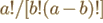 if necessary. The repeated appearance of lengthy expressions should be avoided by introducing suitable notation. Long or important equations should be shown
in a separate line. Equation numbers should be included only for those equations that are referred to in the text and must be placed on the right.
if necessary. The repeated appearance of lengthy expressions should be avoided by introducing suitable notation. Long or important equations should be shown
in a separate line. Equation numbers should be included only for those equations that are referred to in the text and must be placed on the right. must be avoided, as must
 . Subscripts and superscripts should be aligned horizontally, or be clearly marked. Avoid higher-order sub- and superscripts.
 ,
, ,
, ,
, ,
, ,
, ,
, ;
; ,
, ,
, ;
; ,
, ; etc.
.gif) for expectation not
for expectation not
 or
or
.gif) ;
;
.gif) not
not
 ;
; ,... ,
 or
or
 not
not
 . Avoid
 for product.
 and
and
 should be avoided. Follow the usual conventions for brackets, exp, square root sign, etc. as in a recent issue. Do not use
 when the expression inside the square root sign is lengthy.